Learn All About Boy's Puberty
School, Studying, and Grades

index sitemap advanced
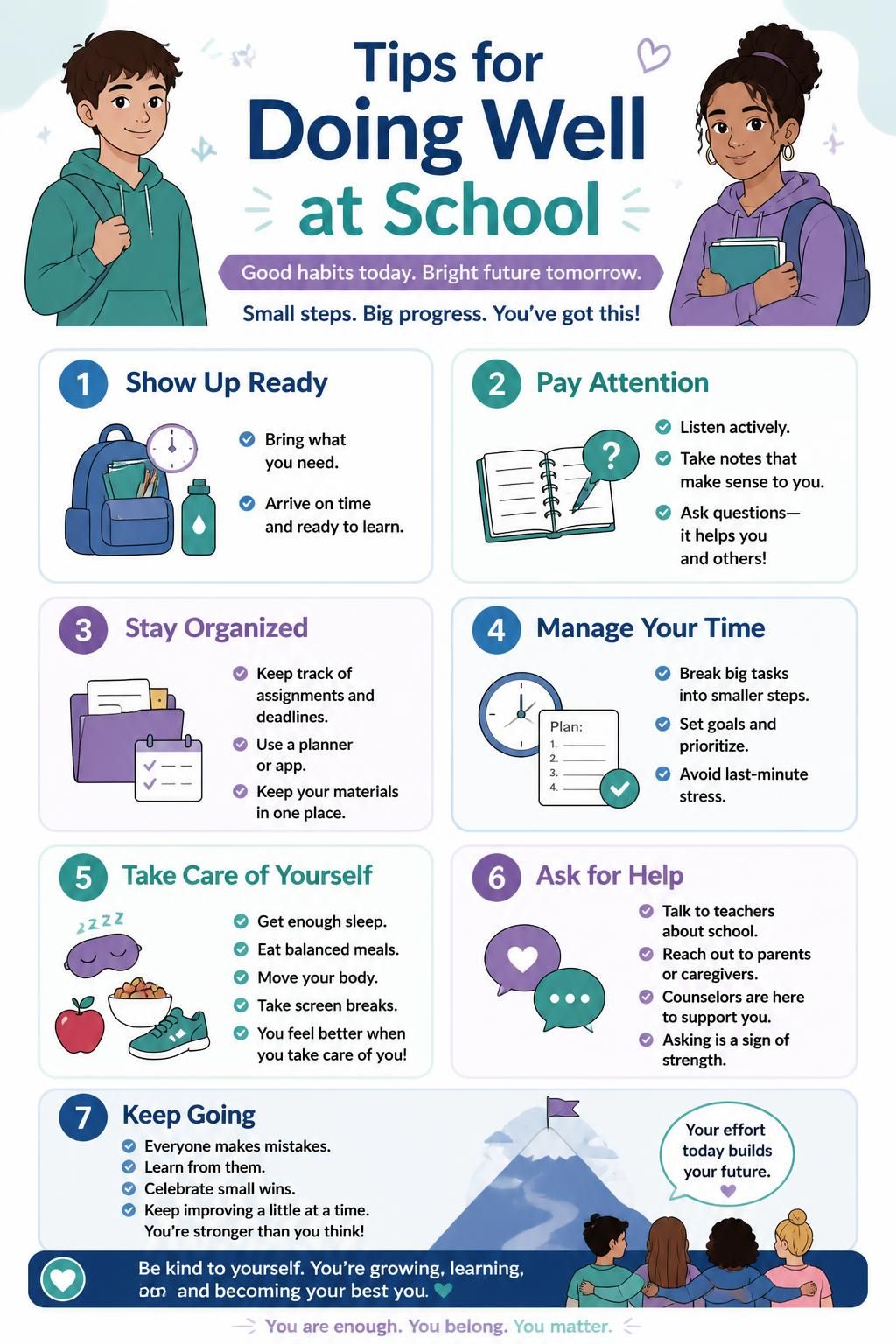
You may not have been taught how to study at school, which is important for teenagers to learn so they can make learning easier, more efficient, and even fun.
People who do well in school often hang around others who do well, too. Some boys pressure others not to do well at school. If this is what is happening to you, tell a trusted adult so they can help you.
One trick for doing better in school is to keep a small notepad with your assignments and test dates written down, so you won't forget. If you don't remember that you have an assignment due tomorrow, you might not complete it.
Also, don't wait until the last minute to start a project or study for a test. Leaving yourself enough time is a great idea.

People who earn good grades often must spend countless hours studying and doing homework. One tactic to help you study more and still have fun is to study for twenty minutes, then do something you enjoy for five minutes, then repeat.
Some students (and we mean some) do not have to study very much and still do exceptionally well at school. But most scholastic achievers spend a lot of time studying.
One way to look at your studies is to imagine you're a sixth grader. Think about it this way: you have three years of middle school and then four years of high school, and then maybe four years of college. If you devote your time and effort for this period, in your young life, to your schoolwork, it will likely pay off for the rest of your life, over many decades.
Doing well at school opens more options for students. Boys will most likely benefit from having as many options in life as possible. If you do well at math and your other studies, you might have the option to be accepted into U.S. Navy flight school after graduating from high school. Doing your best at school is all that can be asked of you. Don’t stress about grades or over-worry about trouble at school.
One helpful tip is to ask your teacher to move to the front of the class.
Your teacher would likely feel happy and appreciated if you saw them during your and their free time to get help with an assignment or schoolwork. Your teacher would probably appreciate you asking questions during class about things you are unsure of. Don't worry about asking a "dumb" question. Several other classmates may have the same question but will not ask for help.
In some subjects, if you do not fully understand and learn one lesson, the future lessons build upon that lesson. If you didn't learn the original lesson, it's difficult or nearly impossible to continue learning new lessons. Algebra classes, for example, are typically exactly like this. If you are having difficulty with a lesson, don't hesitate to ask the teacher questions, see the teacher after class or school, or use a tutor to help you learn.
Amazing memory programs are available that can help people of all ages learn and remember information quickly and efficiently.
One excellent memory program available as an audio download by Dominic O'Brien, Quantum Memory Power: Learn to Improve Your Memory with The World Memory Champion! It can help a student tremendously. It can greatly shorten the time a boy needs to study. It is highly recommended.
Another idea is that you can raise your IQ. A person’s IQ is a measure of their intelligence. Learning the meanings of new words and using them in your everyday writing and talking can raise a person's IQ.
Several vocabulary learning programs are available online as audio downloads. One is WordMaster, by Denis E. Waitley, and another is Verbal Advantage Success Edition by Charles Harrington Elster.
Plus, learning and using new words broadens your lexicon (your vocabulary) and makes you appear smart to other people.